

Dr. Michael Lenarz, D.C.
Founder · Blair Advanced Certified Instructor
Sedro-Woolley clinic
Read his background →Blair Upper Cervical · Seattle & Sedro-Woolley
Many people who find us have already seen the neurologist, tried the medication and heard the scans are clear. Others are just starting to look. Either way, there is one place standard workups skip — the top two bones in your neck, where the spine meets the brainstem. That is where we start, and it is often where the answer has been.
Why people come here
The GP. The neurologist. The ENT. Imaging that came back clean, physical therapy that helped for a week, medication that dulled the edge without touching the cause. Somewhere in there you started to wonder whether anyone was going to find it.
Those tests were looking for disease and structural damage. They were not measuring how your atlas and axis sit at the brainstem — and standard imaging is not taken at the angle that would show it.
That is the thing we look at first.
What we're looking at
Your atlas and axis are the top two vertebrae in your neck. They sit directly at the brainstem, where every signal between brain and body passes through, alongside the vertebral arteries and the flow of cerebrospinal fluid.
When they shift out of position, the interference happens at the busiest junction in the body. That is why a structural problem at the top of the neck can show up as a headache, as dizziness, or as pain in a leg — a long way from where the misalignment actually is.
Blair Upper Cervical care addresses that misalignment. It does not treat disease, and we will tell you plainly if your imaging shows nothing for us to correct.
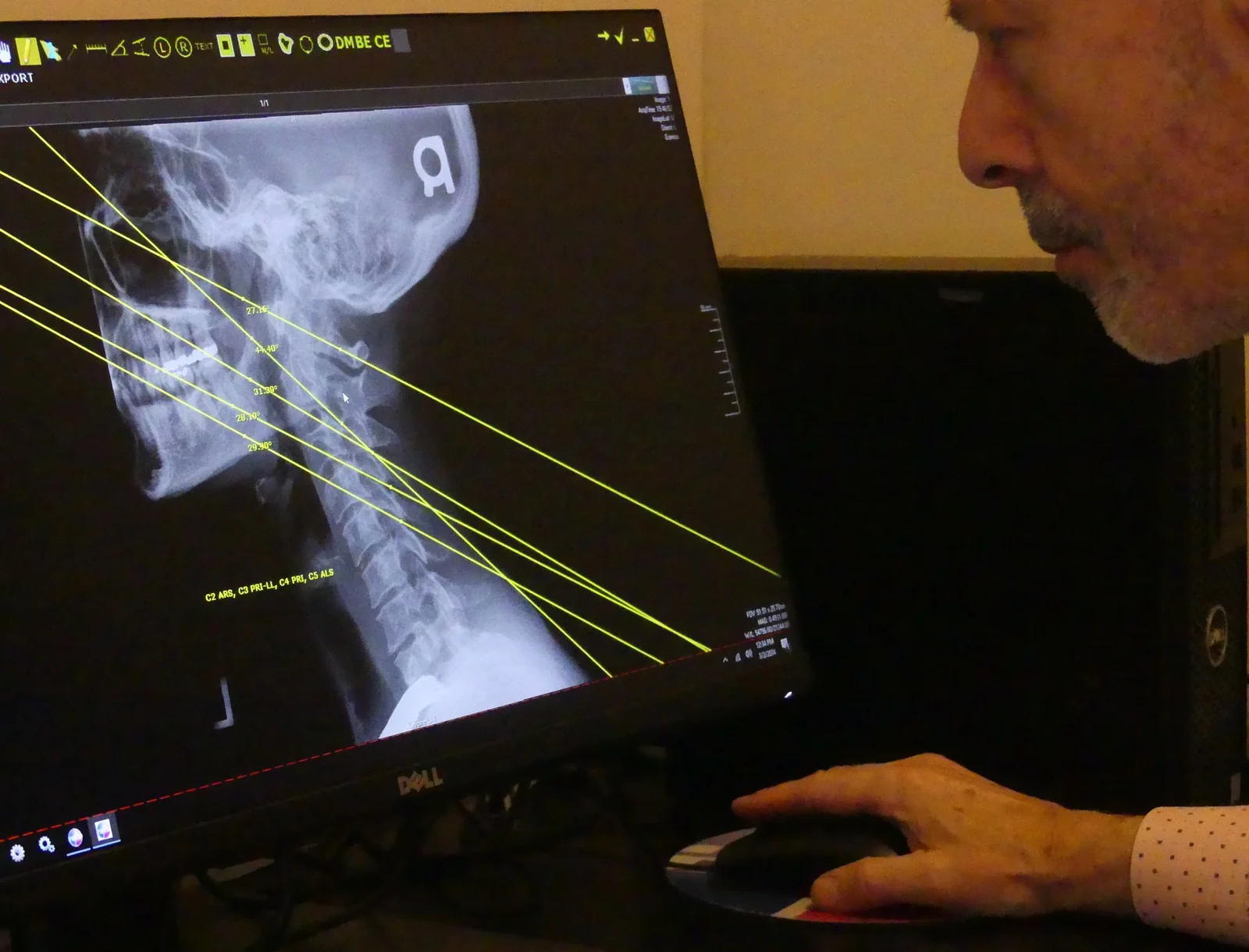
What precise actually means
Those yellow lines are a real Blair analysis. Every joint angle in the upper cervical spine is measured on your own imaging, because no two people's anatomy is the same — the joint planes differ, so the correction has to differ too.
It is the reason there is no standard adjustment in Blair. There cannot be. And it is why we can tell you whether anything is out of place before we decide whether to adjust at all.
What we see most
These conditions share a common thread at the craniocervical junction. Each page explains what we look for and what care involves.
Who you'll see
"The body will always adapt and heal, when given the chance. Give it that chance."
Two doctors, two clinics
Dr. Lenarz trains Blair doctors. Dr. Santos was trained by him and they review cases together — so the analysis is the same whether you are seen in Skagit Valley or on Capitol Hill.
Founder · Blair Advanced Certified Instructor
Sedro-Woolley clinic
Read his background →
Associate Doctor · Seattle Clinic Director
Seattle clinic
Read her background →What patients say
We don't republish patient reviews on our own site. Washington treats a reposted review as our advertising, and we would rather you read them where the patients actually wrote them.
Blair Upper Cervical care addresses vertebral subluxation. It is not intended to diagnose, treat, cure or prevent any disease or condition. Individual patient results vary.
Two Washington clinics
Capitol Hill
Dr. Aixa Santos
1420 E Madison St, Suite 1
Seattle, WA 98122
Skagit Valley
Dr. Michael Lenarz
700 Murdock St, Suite B
Sedro-Woolley, WA 98284
Your first step
One focused examination can tell you whether your upper cervical spine is involved. We review your history, explain what Blair analysis looks at, and image only if it is warranted. If we cannot help you, we will say so and point you somewhere that can — you will leave knowing either way.
Book a consultationNo obligation. We only image if it's warranted, and we'll tell you plainly if we can't help.
Or call the clinic nearest you: Seattle (206) 327-9328Sedro-Woolley (360) 855-1021
Blair Upper Cervical care addresses vertebral subluxation. It is not intended to diagnose, treat, cure or prevent any disease or condition. Individual patient results vary.